
Social media influencers and persuasion
The elaboration likelihood model of persuasion (Petty and Cacioppo, 1986) is a widely used and popular model in consumer research. It has also found application in social media and influencer marketing after the introduction of these new communication channels (Gong, 2020; Teng et al., 2014; Sokolova and Kefi, 2020). ELM assumes that high-involvement subjects will be motivated to go through central cues and persuaded by message arguments (the central route). In comparison, low-involvement subjects will focus on and are more likely to be persuaded by peripheral cues such as source characteristics (the peripheral route) (Cole et al., 1990). SMIs deliver both informative and entertaining content in their specialized areas when communicating with their followers (Lou and Yuan, 2019). By being authentic, followers are able to trust the influencer’s postings (Kim and Kim, 2021), which may intensify an influencer’s persuasive impact. A sense of homophily may stimulate the pursuit of information, and development of interpersonal relationships with influencers, and sharing of information (Bu et al., 2022). Thus, we take the SMIs’ content value, namely, informativeness and entertainment, source characteristics of influencers’ authenticity, and homophily, to test the persuasion power of influencers.
Parasocial relationship in influencer marketing
As an essential concept in media studies, PSR can be defined as unilateral relationships formed by a media audience with a media character (Rubin and Step, 2000). Typically, this is a one-sided, nondialectical, solo-controlled relationship incapable of mutual growth (Horton and Richard Wohl, 1956). It is presumed that PSR serves as a motivating factor in media choices and provides people with a sense of belonging and companionship (Rubin and Step, 2000). SMIs are unable to respond to all comments or requests from their followers and engage in actual discussions due to the large number of followers and reactions on their social media accounts. This situation resembles the development of PSRs with celebrities. (Sokolova and Kefi, 2020). PSR advance the intimate friendships between digital celebrities and influence their succeeding behaviors (Hwang and Zhang, 2018). Yuan et al. (2016) found that PSRs are positively influenced by the motivation to use social networking sites and celebrity source credibility, which results in positive consumer attitudes and customer equity drivers. Researchers have been exploring the role of PSRs for years, but their focus has recently shifted from traditional celebrities to SMIs (Aw and Chuah, 2021). For example, Chen (2014) demonstrated the PSR applies well to the case of influencers and followers through regular content generation and interaction with followers; SMIs can allow followers to form lasting bonds with them. Digital celebrities create PSR through interactions with audiences, giving the illusion of intimacy while promoting products and brands and conducting public relations. Hence, PSRs can be viewed as social media advertising vehicles that can effectively improve advertising outcomes (Lueck, 2012). Recently, studies have found the importance of SMIs’ credibility, users’ characteristics, and content characteristics in fostering the PSR between SMIs and consumers in the context of influencer marketing (Cheung et al., 2022; Hwang and Zhang, 2018; Lou and Kim, 2019).
Antecedents of parasocial relationship
SMIs content value
Ducoffe (1995) developed the advertising value model, in which he defined advertising value as “a subjective evaluation of the relative worth or utility of advertising to consumers.” The model proposes advertising value based on three determinants: informativeness, entertainment, and irritation. While advertising informativeness and entertainment enhance the value of advertising, irritation negatively affects advertising value (Ducoffe, 1995). Influencer marketing can be considered a kind of native advertising in which SMIs advise on diverse topics, cooperate with multiple brands, and publish their content in non-commercial formats (Breves et al., 2021; Dhanesh and Duthler, 2019). SIMs can create content and usually function as creative agencies and advertising media, and several studies have regarded SMIs’ content as online advertisements and investigated its influence on consumers’ responses (Daniel et al., 2018; Enke and Borchers, 2019; Taillon et al., 2020). This study further adopts the two positive elements of advertising value: informativeness and entertainment facets as SMIs’ content value corresponds with Lou and Kim (2019).
The informative value of content
SMI content informativeness can be described as the capability of content to provide information on alternative products or other informative content so that purchases can yield the most excellent satisfaction from a consumer’s perspective (Ducoffe, 1996; Lou and Yuan, 2019). The extent to which the content is informative is a critical quality that affects whether the audience views SMIs as opinion leaders. Since SMIs provide information about a product’s features and quality, or reviews about their personal experiences, they are perceived as trusted sources of information by consumers today (Ki and Kim, 2019). Social media allow SMIs to interact with their followers and share information that consumers seek to acquire. By sharing and posting more informative content about products and brands, SMIs are more likely to exert their influencing effects (Lin et al., 2018). Previous studies have shown that in the social media context, advertising informativeness has a positive effect on brand attitude, which further affects brand awareness and purchase intention (Dehghani et al., 2016). According to Van-Tien Dao et al. (2014), informativeness positively influences consumers’ perception of social media advertising’s value, ultimately affecting their intentions to buy online. Lou and Yuan (2019) proposed a SMIs value model, which demonstrated that the informative value of influencer-generated content positively influences their fans’ trust in influencers’ branded posts and purchase intention. In influencer marketing, informative content has proved to affect followers to perceive SMIs as human brands and lead to a solid emotional bond (Ki et al., 2020). Hence, we propose the following hypothesis:
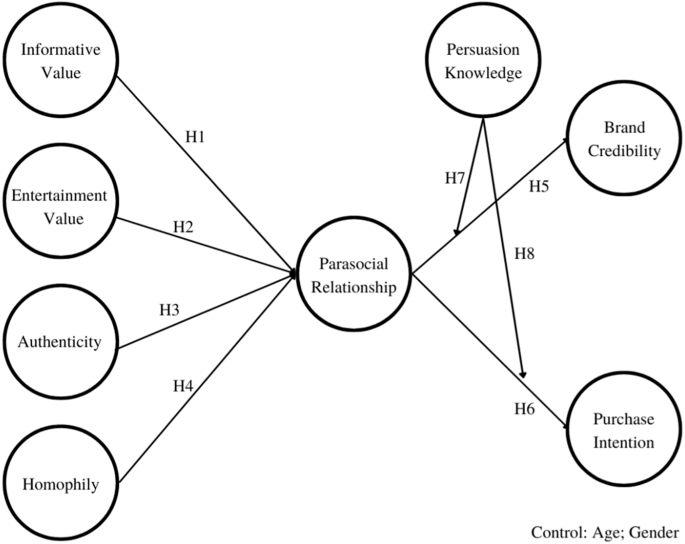
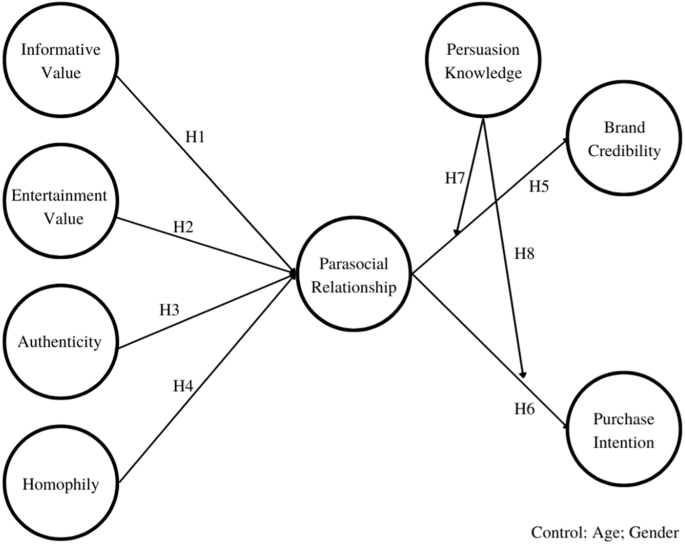
H1: The informative value of influencers’ content will positively influence PSR between influencers and their followers.
The entertainment value of content
SMI content entertainment can be defined as the capability to entertain consumers, which helps audiences escape their daily lives (Ducoffe, 1996; Lou and Yuan, 2019). SMIs can entertain and potentially influence followers’ thoughts, attitudes, and behaviors through personal branding as well as build and maintain relationships with their followers on social media (Dhanesh and Duthler, 2019). Influencers create entertainment content usually through esthetic touches and personality twists (Lou and Yuan, 2019). After conducting in-depth interviews with Chinese social media users, Gan and Wang (2015) found that entertainment strongly motivates Chinese users to use Microblog and WeChat by fulfilling the hedonic gratification of using these social media. Prior studies found that the perception of entertainment influences customers’ attitudes toward web advertising, which in turn impacts their use of web advertising to obtain information (Zha et al., 2014); Entertainment is a hedonic benefit offered by online stores that can excite consumers’ pleasure and influences their approach behaviors (Wu et al., 2019). In the social media context, the value of social media advertising is significantly influenced by entertainment, and consumers’ attitudes and behavior will be positively affected by this value (Hamouda, 2018). Research found that the main reason people use Tiktok is for personal entertainment (Yang and Ha, 2021). According to Lou and Kim (2019), PSR between teenage followers and their favorite influencers is positively associated with the entertainment value of influencer-generated content. Hence, we propose the following hypothesis:
H2: The entertainment value of influencers’ content will positively influence PSR between influencers and their followers.
Influencer authenticity
The definition of authenticity in sociology is being true to oneself; a person experiences authenticity when they are true to themselves (Vannini and Franzese, 2008). A conceptualization of authenticity is adopted in research on social media practice that overlaps with these notions of ‘humanness.’ Still, its foundation lies in the genuineness of one’s personality (Cohen and Tyler, 2016). Followers perceive influencers’ passion and sincerity in creating content and the strength of their internal intentions. To be specific, Influencers who create content with internal motivations, as opposed to those motivated by external or commercial incentives, are considered authentic (Jun and Yi, 2020). Authenticity has been seen as a significant predictor of PSR in traditional and social media contexts (Cohen and Tyler, 2016; Marwick and Boyd, 2011). For example, authenticity has been proven to foster emotional bonds and responses between consumers and celebrities on Twitter (Marwick and Boyd, 2011). Sponsorship on social media is widely known and may make users skeptical of the influencer’s motives for promoting the product/service. By being authentic, followers can believe that influencers are posting their genuine opinions (Kim and Kim, 2021). Studies show authenticity can help build trust between influencers and followers (Lee et al., 2021), eliciting a long-term relationship with the brand (Jun and Yi, 2020) and generating a positive attitude toward the brand (Kim and Kim, 2021). Accordingly, we propose the following hypothesis:
H3: Influencers’ authenticity will positively influence PSR between influencers and their followers.
Influencer homophily
Lazarsfeld and Merton (1954) proposed the theory of homophily that the majority of human communication will take place between sources and seekers who are homophilous. The homophily described by Gilly et al. (1998) entails comparable values, preferences, lifestyles, and demographic similarities. There has been a relatively limited study of homophily in marketing and social commerce; it refers to perceptions of similarities between SMIs and their followers regarding attitudes, values, morals, appearance, and backgrounds (Ladhari et al., 2020). Aaker et al. (2000) found a link between the perceived similarity between an endorser and a consumer and advertising attitudes. According to Munnukka et al. (2016), an endorsement’s similarity is crucial in establishing credibility between peers, further influencing advertising effectiveness and attitude formation. Consumers will assume that the provided information is helpful and similar to their preferences when considering the information source homogeneous (Filieri et al., 2018). In recent research, source homophily can influence consumers’ behavioral engagement and purchase intention (Onofrei et al., 2022). Compared to traditional celebrities, consumers feel more similar to influencers and trust them more (Schouten et al., 2019). Ladhari et al. (2020) found that followers of SMIs who perceive influencers as similar in attitudes, values, and appearance are also more likely to connect with and be emotionally attached to them. Drawing upon these arguments, we hypothesize that:
H4: Influencers’ homophily will positively influence PSR between influencers and their followers.
PSR and followers’ perceived brand credibility and purchase intention
Brand Credibility
Brand credibility, as perceived in terms of expertise, trustworthiness, and likability, reflects how customers view a brand’s credibility (Keller, 2013). Thus, A brand’s credibility is determined by its ability and willingness to consistently deliver what has been promised concerning the product information contained in the brand (Erdem and Swait, 2004). The brand’s credibility indicates the quality and positioning of the product, and customers will feel more confident in the brand’s products and be more loyal to it when it has a highly credible brand (Alam et al., 2012). Scholars have used brand credibility as an outcome to measure the effectiveness of advertising and marketing (Dwivedi et al., 2019; Wang and Scheinbaum, 2017). Lee and Watkins (2016) demonstrate that a positive PSR with vloggers influences luxury brand perceptions (e.g., brand value, brand-user image fit, and brand luxury). Through social media, PSRs were associated with more significant source trustworthiness, positively affecting brand credibility (Chung and Cho, 2017). Reinikainen et al. (2020) suggest that when consumers have PSRs with influencers, they can develop trust in the brand recommended by the influencers and reduce their uncertainty about the brand. To further test the PSR effect on consumers’ perceived brand credibility, the next hypothesis is formulated as follows:
H5: The PSR between influencers and their followers will positively influence followers’ perceived brand credibility.
Purchase intention
Purchase intention, as a social media campaign outcome, can be helpful to marketers when collaborating with SMIs (Tanwar et al., 2022). Most purchases are motivated by attributes or characteristics of the brands that match the buyer’s purchase motive. It is common for a purchase intention to take some time to become a purchase and plays a vital part in predicting purchase behavior (Guolla et al., 2020). Many advertisers and scholars have routinely used purchase intentions to evaluate the effectiveness of marketing strategies (Van-Tien Dao et al., 2014; Onofrei et al., 2022; Taillon et al., 2020). Using celebrities as marketing tools, marketers create strong relationships between the brand and the celebrity, thereby increasing consumers’ purchase intention (Guolla et al., 2020). Djafarova and Rushworth (2017) demonstrated that young female Instagram users perceive SMIs as more credible and can relate to them than traditional celebrities, making them more effective in influencing their purchase behaviors. According to Lou and Kim (2019), purchasing intentions toward products promoted by influencers will be positively correlated with adolescents’ perceived PSR with influencers. And regardless of high or low product involvement, PSR between microbloggers and their followers has salient positive effects on followers’ attitudes and behavioral intentions (Gong, 2020). Hwang and Zhang (2018) found that the PSR between Chinese SNS users and digital celebrities has positively affected users’ purchase intention. Based on the previous findings, the following hypothesis is advanced:
H6: The PSR between influencers and their followers will positively influence followers’ purchase intentions toward influencer-promoted products.
Persuasion knowledge as a moderator
According to the persuasion knowledge model, consumers use persuasion knowledge to deal with marketers’ persuasive attempts, which can influence their brand attitudes and responses to marketers’ advertising and sales promotions (Friestad and Wright, 1994). Conceptual and attitudinal persuasion knowledge are the two dimensions of persuasion knowledge. While conceptual persuasion knowledge encompasses advertising knowledge, including the ability to recognize and understand the persuasive intent, attitudinal persuasion knowledge describes potentially effective attitudes in dealing with advertising (Boerman et al., 2012). Followers know that influencers are paid for their endorsements, regardless of whether they disclose them. As a result of this awareness, they recognize SMIs’ content as advertising and are ready to process persuasive messages from SMIs (Dhanesh and Duthler, 2019). Similarly, Lee and Kim (2020) also found that explicit sponsorship disclosure language did not enhance advertising recognition as implicit disclosure language and no disclosure in Instagram posts; all respondents reported some conceptual persuasion knowledge. Previous research was limited in investigating the relationship between SMIs and consumers’ persuasion knowledge (Breves et al., 2021; De Jans and Hudders, 2020; Lee and Kim, 2020; Van Reijmersdal et al., 2016). For example, Van Reijmersdal et al. (2016) found that participants activated their persuasion knowledge due to disclosing sponsored blog content, which decreased persuasive arguments’ effectiveness. Hwang and Zhang (2018) demonstrated that PSR could enhance persuasive effects by reducing the negative impact of persuasion knowledge on followers’ eWOM and purchase intention. The study from Breves et al. (2021) indicates that, unlike users who did not follow any influencers, followers demonstrated lower levels of activated persuasion knowledge due to the established PSR between them. As a consequence, followers reported higher brand evaluations and purchase intentions. Marketing outcomes are more likely to be deeply influenced by effective relationships between users and SMIs. However, users’ persuasion knowledge triggers more significant skepticism or greater credibility (Isaac and Grayson, 2016), which may diminish or fortify followers’ evaluation of SMIs’ authenticity about the brand, product, or service they promote on social media. Therefore, the hypothesis is formulated as follows:
H7: Followers’ persuasion knowledge will moderate the relationship between PSR and the endorsed brand credibility.
H8: Followers’ persuasion knowledge will moderate the relationship between PSR and purchase intention.
Previous studies on influencer marketing revealed that demographic factors: age and gender could affect model testing (Cheung et al., 2022; Lou and Yuan, 2019; Yuan and Lou, 2020); hence, we included them as control variables. The conceptual model that summarizes this research is proposed (see Fig. 1).
link