

This article was originally published in The Setonian on November 18, 2025.
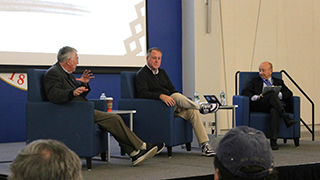
From left to right) Bob Ley, Burke Magnus, and Len DeLuca | Photo via Christian Hui
| “The Setonian”
In January 1996, Microsoft founder Bill Gates wrote an essay titled “Content is King,” from which the now-popular phrase originated. With the rise of the internet, Gates
suggested that producing a volume of high-quality, engaging content would lead to
success in the future of media.
Few have taken heed of Gates’ phrase quite like Burke Magnus, ESPN’s president of
content. “It’s a cliche for a reason,” Magnus said. “People want what they want, and
if you’re not giving it to them, they’ll find another place to get it.”
Promoted to the role in March 2023, Magnus oversees ESPN’s wide content organization
— including studio shows, live events, newsgathering, investigative journalism, original
content, digital and audio platforms and social media. In doing so, he ensures that
the network is living up to Gates’ phrase — the network produces 50,000 live events
each year after all.
A native of Ridgewood, NJ, Magnus has been one of ESPN’s most impactful members since
joining the network in 1995. From November 2004 to March 2008, he served as vice president
and general manager of ESPNU. A decade later, as executive vice president of programming
acquisitions and scheduling, he helped launch ESPN+, the network’s direct-to-consumer
service. Now in his 30th year with the network, he has played a key role in securing
some of ESPN’s biggest agreements and extensions. These include deals with major American
sports leagues like the NFL, MLB and NBA as well as international leagues like LaLiga
and the Bundesliga.
On November 17, the Seton Hall Sports Poll and Sports Management and Analytics Club (SMAC) welcomed Magnus for a series of events including: a one-on-one chat with Center for Sport Management Instructor and poll Associate Director Leonard “Len” DeLuca; a second interview with poll Methodologist Dan Ladik for a segment of Hall or Nothing, the Sports Poll’s podcast; and a visit to the Sports Poll itself as well as the
Center for Sports Media (CSM) — the latter of which was founded by Bob Ley, an ESPN icon and former colleague of
Magnus who joined him and DeLuca on stage later on in their chat.
After a short game of trivia and a cinematic introductory video featuring Walt Disney,
Magnus and DeLuca joined each other on stage for the first of these events. Former
colleagues at CBS Sports — where Magnus once interned for DeLuca — and later at ESPN,
the two first discussed the network’s recent landmark agreements with the WWE and
NFL Network, both announced in August of this year.
Starting with the former, according to the network’s press release, the “deal makes
ESPN home to the highest-profile WWE events of the year.” This includes WrestleMania,
SummerSlam, Royal Rumble, Survivor Series and Money in the Bank — all of which will
be available exclusively on ESPN’s various platforms and services going forward.
The latter agreement, however, is perhaps ESPN’s biggest to date — so much so that
The Walt Disney Company was willing to give up ten percent of their 80 percent ownership
stake in the network to secure it. According to the network’s press release, in exchange
for a ten percent equity stake, “ESPN will acquire NFL Network and certain other media
assets owned and controlled by the NFL — including the NFL’s linear RedZone Channel
and NFL Fantasy.”
This came just four years after the two sports media powerhouses reached a long-term
agreement that resulted in ESPN gaining the broadcasting rights to Super Bowl LXI
on February 14, 2027, with preparations starting a year in advance. “Valentine’s Day
and the Super Bowl on the same day,” Magnus said during his chat with DeLuca. “Let’s
see how society grapples with that one.”
The two also discussed sports betting in the wake of ESPN recently entering into a
new partnership with DraftKings after they mutually parted ways with PENN Entertainment
Inc., putting an end to ESPN Bet.
Not one to bet himself, Magnus expressed that he is conflicted about sports betting,
seeing it as flawed yet pervasive.
“It was illegal for a reason,” Magnus said. “Bad things can happen, and unless there’s
great oversight and responsible messaging and people taking personal responsibility
— it’s not without its pitfalls and its perils.”
“But with that being said, there’s not a single league, team, athlete, media company
or sports division that doesn’t have some kind of relationship with one of the sports
betting companies either through their advertising or sponsorship,” he added. “So
everybody’s kind of in this together.”
In light of recent events, however, Magnus said he’s encouraged by how major leagues like the MLB and NBA have taken proactive steps to prevent future sports betting scandals from happening
in their respective sports.
But perhaps the most important thing Magnus shared during the event was his advice
for those who aspire to work in the sports media industry one day. For him, being
open to opportunity — regardless of whether it aligns with your vision for your future
career or not — is the main catalyst for success.
“I sit with a lot of young folks who are looking to get into this business, and sometimes
they come in with a very specific vision for themselves,” he said. “They’ll say, ‘I’m
a huge NBA fan, and I only want to work on the NBA.’”
“But opportunity comes in so many forms, and it can be right in front of you, and
if you don’t have the mindset to sort of look at it with a broad perspective, even
though it doesn’t fit your vision of how you saw your career going.”
He pointed to his own experience as proof of how being open to opportunity in an industry
like sports media can be fruitful.
“I had a conventional career in undergrad, and I went back to grad school, and long
story short, I started over my career because I wanted to work in sports so desperately,
and I finally admitted that to myself,” Magnus said. “So you can make a lot of mistakes
early in your career — and not even mistakes, you can choose paths and if it doesn’t
work out, choose something else. But being cognizant of opportunity when it’s in front
of you [is what’s important].”
Still using himself as an example, he also mentioned how one of his first big breaks
at ESPN came when he worked on NASCAR in the programming department — something no
one else wanted to do.
After the event, he offered further advice for students, emphasizing what he believes
is the most important thing for students to know about how content is produced in
the sports media industry.
“It’s very, very individual, very personal,” he said. “Between everything on television,
social and digital, you can customize stuff to appeal to audiences better than ever.”
“There’s still the mass audience property in sports, where you put on big games that
are supposed to aggregate tons of people,” he added. “But don’t forget about people
feeling different about sports based on where they live and what they want, which
is really unique to the era that we’re in right now.”
He also shared what students can learn from figures like Stephen A. Smith and Pat
McAfee, who are the two biggest and most influential names at ESPN.
“I think if you’re a content creator, take matters into your own hands,” he said.
“Both of those guys have very specific visions for themselves and their own brands,
they’ll make it happen.”
“So you don’t have to necessarily rely on a platform and outlets,” he added. “And
if you have a really dedicated vision for yourself, you can pursue it on your own.”
Before heading to his next event on campus, Magnus reiterated that those aspiring
to work in the sports media industry one day will go only as far as their passion,
endurance and curiosity takes them.
“Just work hard, be curious and just keep plugging away,” Magnus said. “If this is
your passion, then you should pursue it, and just understand that it takes a lot of
different forms along the way, so just stick with it.”
“I didn’t think liking sports or being a sports fan as a kid made me particularly
unique,” Magnus added. “But just believe in yourself and work hard — it’s not that
complicated.”
After the event, DeLuca reflected, “My takeaway after interviewing my friend and colleague
Burke Magnus is that the folks in Bristol and worldwide covet their position as an
insurgent, not an incumbent, despite having over 50,000 events — as many as their
traditional competitors. Like Walt Disney himself said half a century earlier, ESPN
will approach the Super Bowl in 2027 as the company’s greatest event. ESPN always
takes the attitude of the ‘little engine that could.’ That’s their secret.”
He added, “Further Burke has become agnostic to platform because the fans demand it,
and ESPN is smart to understand that sports content is king. It understands its audience
better than most and serves as an example for all corporations in my opinion. Finally,
I’m further taken that a day after he visited us, Burke and ESPN closed their new
MLB deal and a day later Stephen A. Smith declared his departure from NBA Countdown.
Yet on Monday, he was with us at Seton Hall. A great day for all.”
Categories:
Athletics
link