

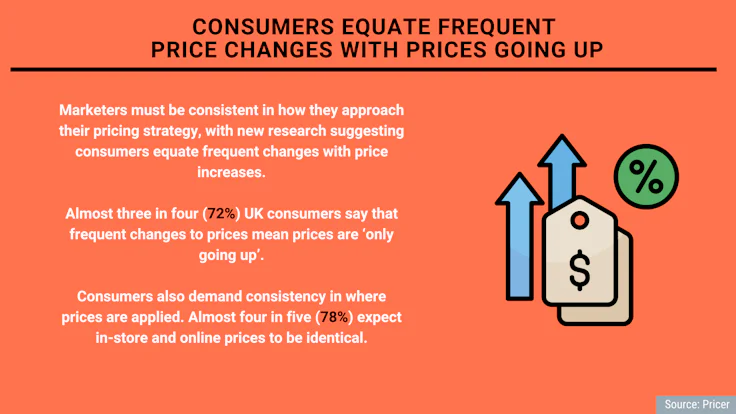
Consumers equate frequent price changes with prices going up
Marketers must be consistent in how they approach their pricing strategy, with new research suggesting that consumers equate frequent changes with price increases.
Almost three in four (72%) UK consumers say that frequent changes to prices mean prices are ‘only going up’.
Consumers also demand consistency in where prices are applied. Almost four in five (78%) expect in-store and online prices to be identical. The same proportion (78%) say promotions should apply across all channels and two-thirds (66%) are frustrated by offers that are only available in one place.
The current economic environment is impacting UK shopper behaviour, with 78% of shoppers saying they are now more price conscious. Just under three-quarters (74%) actively seek discounts and promotions, and the same number (74%) compare prices at the shelf.
Almost two-thirds (63%) of shoppers say they split their shop across multiple stores to get the best prices.
Source: Pricer
Global alcohol volumes expected to decline faster than expected
 Global beverage alcohol volume is expected to decline by 0.4% this year, a sharper drop than the previously forecast 0.2%, according to alcohol insights company IWSR.
In value terms, the decline is forecast to be even more steep, IWSR is now forecasting a year-on-year decline of 0.7%, having previously projected a 0.5% decline.
These forecast declines could have wide-reaching consequences for the alcohol industry, with big brewers and major spirits companies facing a challenging backdrop, where global consumers are buying less alcohol.
On a category level, the wine business is forecast to see the steepest declines in 2025. It is projected to decline by 2.4% this year. Spirit volumes are forecast to decline by 1.3% this year.
One potential bright spot for spirits businesses this year is the projected growth of the ready-to-drink (RTD) category. The category is forecast to grow by 1.3% this year, with spirits businesses such as Diageo and Pernod Ricard investing more heavily in RTD.
When predictions were first made in May, beer volume had been expected to grow by 0.2%. However, it’s now forecast to decline by 0.2%.
Source: IWSR
Coca-Cola ranked as top FMCG brand in driving shelf conversion
 Coca-Cola has been ranked as the top FMCG brand in Western Europe for its success in driving conversions, according to a new metric from NielsenIQ (NIQ).
The new metric is NIQ’s Brand Traction score, which is designed to capture how effectively brands convert shelf presence into purchases from consumers. The measure combines insights from NIQ’s Consumer Panel, which tracks how frequently shoppers buy a brand, and its Retail Measurement data, which captures how widely and deeply that brand is distributed across stores.
The data, which covers Western Europe including the UK, Germany and France, shows Coca-Cola as the FMCG brand with the highest traction score of 487, suggesting high effectiveness in driving conversion from shelf presence to consumer purchase. Soft cheese brand Philadelphia achieves the second highest traction score of 458, with Nutella coming in third with 426.
Across the top 15 brands as ranked by NIQ, what the company terms “indulgent” brands lead in driving shelf presence to conversion.
The data also provides insights as to where FMCG brands are finding growth. With some of the top-performing brands growing by 40% due to expanding their presence, with more than 60% of their unit growth coming from increasing the number of households adding these brands to their category repertoire.
There was also growth (18%) from existing buyers expanding their brand and category purchases, while only a third of total growth came from competitive steal.
Source: NIQ
UK marketers ahead of the curve when it comes to AI confidence
 UK marketers are slightly ahead of the curve when it comes to confidence in their ability to use AI tools and technology, but there still remains a gap between adoption and having the necessary skills to make the most of them.
New research from MiQ titled The AI Confidence Curve, based on a study of more than 3,000 marketers, shows that over half of UK respondents (53%) are “fully confident” in their understanding of AI – outstripping the global average of 49%.
In particular, UK marketers are confident around using AI to extract insight and intelligence (51% versus 45% globally), to help drive efficiencies (47% versus 45% globally) and relying on bespoke tools developed internally (48% versus 43% globally).
Despite a global widespread acceptance that AI tools need to be adopted – with 68% currently using AI tools and 72% of marketers planning to adopt more over the next 12 months – less than half (45%) feel confident in their ability to apply them successfully.
It is this 27% difference that MiQ dubs the “confidence gap” where ambition for AI has outstripped the ability of those applying it.
As to what is driving this gap, the research reveals that over a third of marketers (38%) don’t feel they have had sufficient training on working with AI tools effectively. Meanwhile, four in 10 are struggling to share the data they have with existing AI tools creating an integration challenge, and another 38% believe their organisation isn’t doing enough to push the adoption of AI tools.
Source: MiQ
Physical availability is B2B’s biggest growth opportunity, finds research
 B2B marketers are excellent at driving recall but poorer at ensuring their brands are present when and where buyers are ready to act, finds research from the LinkedIn B2B Institute and the Ehrenberg-Bass Institute.
It suggests most B2B brands show up in only three to four marketing or sales channels, while buyers engage with an average of 32 touchpoints across a buying journey.
The research reaffirms that the path to market share lies in penetration, not loyalty. In other words, growth comes from reaching more buyers, especially those not yet in-market.
The research also emphasises the importance of “prominence”. B2B brands spend 82% of their search budgets renting visibility through generic keywords, the LinkedIn B2B Institute emphasises.
This is despite branded search journeys being 19 times more efficient. Yet in categories such as cybersecurity, only 14% of searches even include a brand name. This results in billions spent “renting” temporary prominence rather than owning it.
Source: LinkedIn B2B Institute and the Ehrenberg-Bass Institute.
link